Sperm quality does not depend solely on its motility or external appearance. One of the most important, and often unknown, factors in male fertility is sperm DNA fragmentation, i.e. the degree of damage to the genetic material of the sperm. When this fragmentation is high, it can hinder fertilisation, affect embryonic development and even reduce the chances of implantation. Therefore, once the necessary diagnostic tests have been carried out, it is essential to select the most appropriate technique to optimise the semen sample and thus reduce sperm DNA fragmentation.
Preparation of semen prior to assisted reproduction treatment
Before performing intracytoplasmic sperm injection (ICSI), sperm must undergo a preparation process. The aim is to select those with the greatest reproductive potential and eliminate factors that may interfere with fertilisation.
Traditional methods of sperm selection
The classic methods of semen preparation are:
- Density gradient
- Swim-up
Both involve centrifugation processes and are mainly based on selecting the sperm with the best motility. However, the fact that a sperm is motile does not guarantee that its DNA is intact or that it is capable of generating an embryo with implantation capacity. For this reason, in certain cases, more advanced techniques are used, which allow sperm to be selected based on other parameters, such as DNA fragmentation.
Advanced techniques to reduce sperm DNA fragmentation
Among the techniques that have proven useful in reducing DNA fragmentation, the following stand out:
- MACS (Magnetic Activated Cell Sorting)
- Microfluidic techniques (such as Fertile Chip or ZyMōt-ICSI)
These techniques are highly selective, significantly reducing the number of sperm obtained. For this reason, they are used exclusively in in vitro fertilisation treatments and are not indicated for artificial insemination (AI).
MACS: selection of healthier spermatozoa
The MACS (Magnetic Activated Cell Sorting) technique allows for the selection of higher quality sperm, eliminating those that have begun a process of programmed cell death, known as apoptosis. When a sperm cell undergoes apoptosis, its DNA can become fragmented. Although some of these sperm cells remain motile, they exhibit changes in their cell membrane that allow them to be identified.
How does the MACS technique work?
- The semen sample is initially processed using conventional techniques.
- Subsequently, antibodies attached to magnetic microspheres and to a molecule called Annexin V, which binds to apoptotic spermatozoa, are used.
- The sample is passed through a magnetic column, which retains the damaged spermatozoa.
- The sperm that pass through the column are the healthiest and have the lowest risk of DNA fragmentation, and these are the ones used for microinjection.
Microfluidic techniques: selection without centrifugation
Microfluidic techniques represent one of the most recent innovations in assisted reproduction laboratories. Unlike traditional methods, they do not require centrifugation, which reduces mechanical stress on the sperm. These techniques mimic the natural path taken by sperm in the female reproductive tract, using microscopic channels and very small volumes.
What can be achieved with microfluidics?
The aim is to recover sperm with:
- Better morphology
- Less DNA fragmentation
- Greater reproductive potential
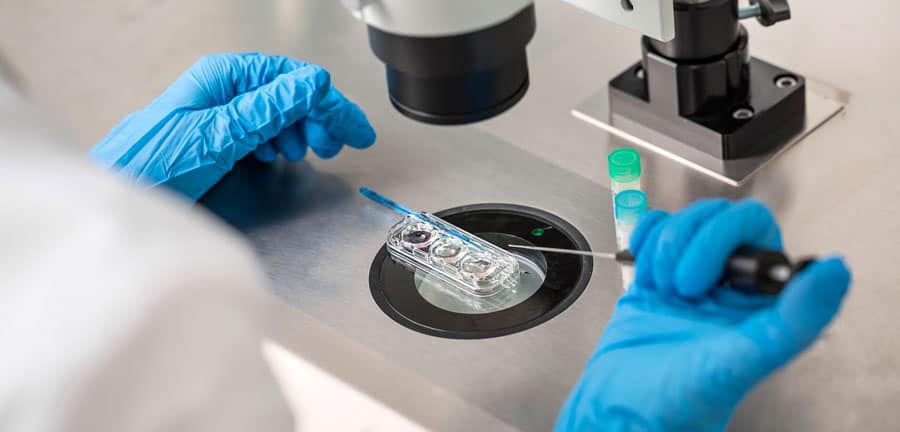
Most commonly used devices The most commonly used devices today are Fertile Chip and ZyMōt-ICSI. Both consist of two compartments connected by a microfluidic channel. The procedure is simple:
- A small amount of fresh semen is placed in the inlet compartment.
- After about 30 minutes of incubation, the most competent sperm naturally migrate to the output compartment.
- From there, the sperm with the best prognosis are recovered for sperm microinjection.
When is it advisable to use these techniques?
The indication for MACS or microfluidic techniques must always be made on an individual basis, following a medical and laboratory assessment. Their use is particularly indicated in cases of:
- High sperm DNA fragmentation
- Previous implantation failures
- Recurrent miscarriages
- Seminal abnormalities
A personalised approach for each case Sperm DNA fragmentation is not an isolated diagnosis or a definitive sentence. Each sample, each couple and each treatment requires an individualised assessment, based on medical criteria and coordinated work between the laboratory and the clinical team. At URE Centro Gutenberg, we select the most appropriate technique for each case, using advanced technology in our laboratory and always with a clear objective: to optimise the chances of success by taking care of every detail of the process.
Would you like to know if any of these techniques can help you?
If you have any questions about sperm DNA fragmentation or which selection method is best for you, our medical and embryology team can assess your situation on an individual basis. Request your first free consultation and take the next step with the peace of mind that comes from being in the hands of a team with over 35 years of experience in assisted reproduction URE Gutenberg Centre,Malaga’s leading fertility clinic.