
A semen analysis, also known as a spermiogram or seminogram, is one of the first tests we carry out to assess male fertility. This analysis tells us the number, motility and morphology of the sperm, and can also detect possible abnormalities that may make it harder to achieve a pregnancy.
At URE Centro Gutenberg, semen analysis helps us assess the man’s reproductive capacity and, together with the woman’s fertility work-up, determine which assisted reproduction treatment may be most suitable: artificial insemination (AI) or in vitro fertilisation (IVF). To interpret the results, we use the parameters established by the World Health Organization (WHO) as our reference, as set out in the sixth edition of its laboratory manual for the examination of human semen, published in 2021. It is important to remember that an abnormal semen analysis does not necessarily mean infertility. The results should always be assessed on an individual basis.
What does a semen analysis examine?
A semen analysis provides a complete study of the semen sample through two types of examination:
- Macroscopic examination: analyses characteristics such as the volume, appearance, pH, liquefaction and viscosity of the semen.
- Microscopic examination: studies the concentration, motility and morphology of the sperm, as well as the presence of other cells or possible abnormalities.
When results fall outside the reference values, we may recommend further tests, such as sperm vitality tests, hormone tests, immunological studies or semen cultures, depending on each case.
Macroscopic examination: which values are studied
The macroscopic examination analyses the general characteristics of the semen before the sperm are studied under the microscope.
Ejaculate volume
According to the 2021 WHO reference values, semen volume should be around 1.4 ml or more. A lower volume may be related to various circumstances, such as incomplete collection of the sample or certain conditions that affect male fertility. Before a semen analysis, a period of sexual abstinence of between 2 and 5 days is generally recommended, following the laboratory’s instructions.
Semen pH
The pH tells us how acidic or alkaline the seminal fluid is. It usually has a value of 7.2 or higher. When it is abnormal, it can provide information about how the glands involved in producing semen are working.
Liquefaction
After ejaculation, semen has a thicker consistency that gradually becomes liquid. This process is usually complete within approximately 60 minutes.
Appearance and viscosity
A semen sample usually has a homogeneous, greyish appearance. We also study its viscosity, that is, how easily it flows. If we find any significant abnormalities, these will be recorded in the semen analysis report.
Microscopic examination: concentration, motility and morphology
This part of the semen analysis is particularly important because it tells us about the characteristics of the sperm.
Sperm concentration
This indicates how many sperm there are in each millilitre of semen. According to the WHO (2021), the lower reference limit is 16 million sperm per millilitre. We also take into account the total number of sperm in the ejaculate, for which the lower reference limit is 39 million.
Sperm motility
It is not enough for sperm to be present in the sample: it is also important to know how they move. We distinguish between:
- Progressive motility: sperm that move forward effectively.
- Non-progressive motility: sperm that move, but without moving forward effectively.
- Immotile sperm: sperm that show no movement.
The WHO lower reference limits are:
- Progressive motility: 30%.
- Total motility (progressive and non-progressive): 42%.
Reduced motility can make it harder for sperm to reach and fertilise the egg.
Sperm morphology
Morphology studies the shape and structure of the sperm, including the head, the midpiece and the tail. According to the reference criteria, the percentage of normal forms should be 4% or more. This does not mean that the rest of the sperm are necessarily unable to fertilise an egg. Morphology is one of the parameters we assess as part of the overall fertility study.
Sperm vitality
In certain circumstances, we also study what percentage of the sperm are alive, especially when motility is very low. It is important to distinguish between an immotile sperm and a dead one, as they are not the same thing.
Presence of other cells and agglutination
During the analysis, we may also observe the presence of leukocytes, red blood cells or clumps of sperm. These findings may point to possible inflammatory or infectious processes or other abnormalities, although on their own they are not enough to make a diagnosis.
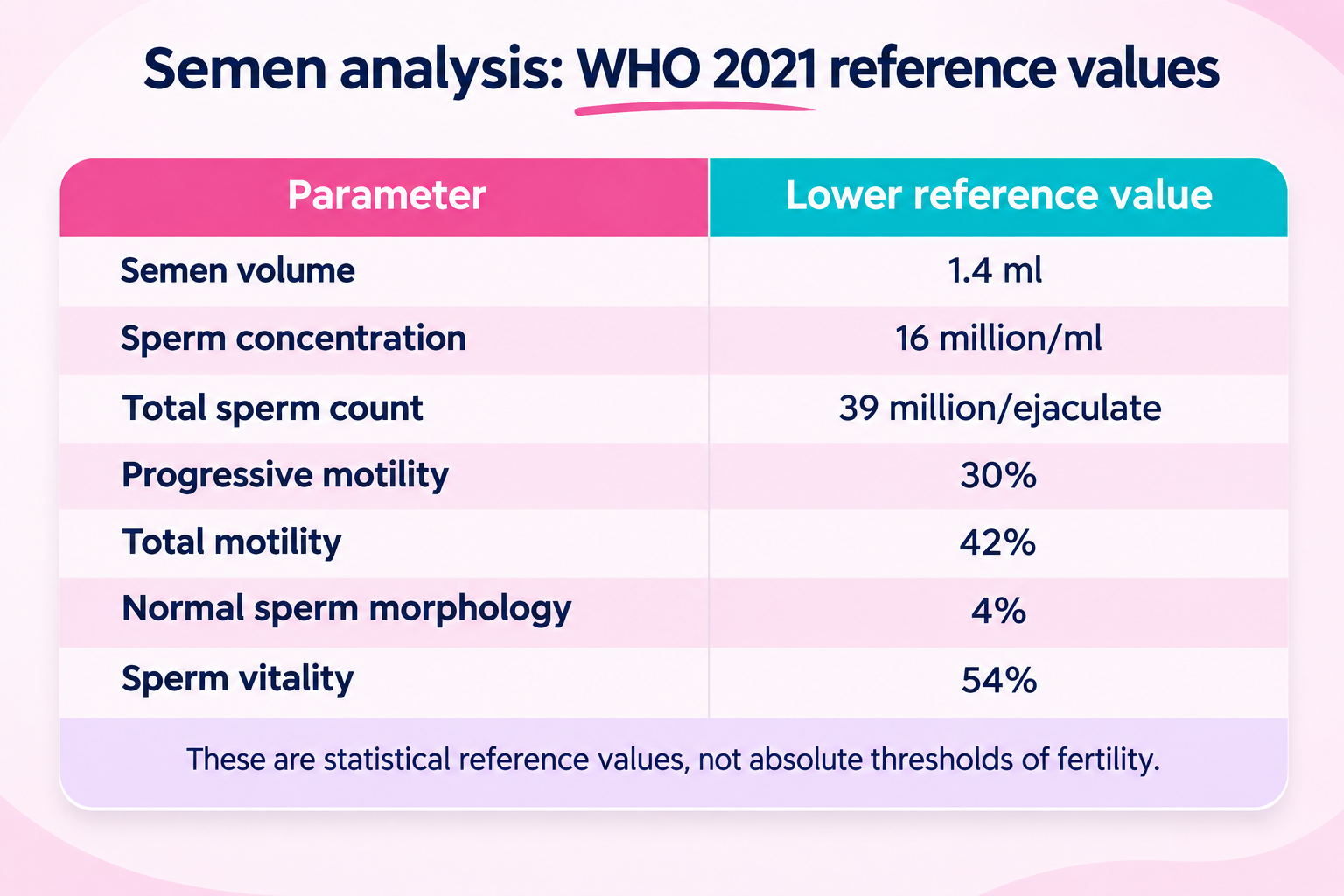
Semen analysis reference values according to the WHO (2021)
To make the results easier to interpret, these are some of the main lower reference limits:
Semen analysis terminology
As you can see, there are quite a few important values involved in a semen analysis. As part of the terminology we use in assisted reproduction clinics, you will also hear us talk about the following concepts:
- Hypospermia: when the volume is below 1.5 ml.
- Oligozoospermia: sperm concentration below the reference value.
- Cryptozoospermia: when the sperm concentration is very low.
- Azoospermia: when there is a complete absence of sperm in the ejaculate. You can read more about azoospermia and assisted reproduction here.
- Asthenozoospermia: refers to motility; it is considered asthenozoospermia when the percentage of progressively motile sperm is below 32%.
- Teratozoospermia: when the percentage of normal sperm is below 4%.
- Necrozoospermia: the presence of a high percentage of dead sperm. This should not be confused with a lack of motility.
Sometimes several abnormalities may appear at the same time.
What if my semen analysis is abnormal?
The first thing is not to jump to conclusions. Semen parameters can vary from one sample to another, so depending on the result, it may be advisable to repeat the analysis or carry out further tests. Our medical team will assess the results as part of the complete fertility study to determine the next steps.
Artificial insemination or IVF? How do semen analysis results influence the choice?
Semen analysis is a key test for guiding the choice of assisted reproduction treatment, but it is not the only factor we take into account. When semen quality is adequate and other requirements are met, artificial insemination (AI) may be an option. For this, it is important to have a sufficient number of motile sperm, as well as to assess factors such as the woman’s age and whether the fallopian tubes are open. When we find significant abnormalities in sperm concentration or motility, the chances of success with insemination may be lower. In these cases, in vitro fertilisation (IVF) may be recommended. Within IVF, the ICSI technique involves injecting a single sperm directly into the egg, which can be particularly useful in certain cases of male factor infertility. At URE Centro Gutenberg, we study each situation individually to recommend the treatment best suited to each patient’s circumstances.
Can semen quality be improved?
In some cases, certain lifestyle changes can help improve male reproductive health. Eating a balanced diet, exercising, avoiding tobacco and cutting down on alcohol are some of the recommendations that may support semen quality. We recommend reading our article on habits to improve male fertility, as well as our guide to diet and male fertility. However, when there is a significant abnormality, it is essential to identify its possible cause and assess the options available.
Do you have questions about your semen analysis results?
At URE Centro Gutenberg, we know that receiving an abnormal result can raise a lot of questions. But remember that a semen analysis is only one part of the fertility study, and there are different options for trying to achieve a pregnancy.
Our medical team can help you interpret your results and assess which tests or treatments may be necessary in your case. Book your free first consultation, in person in Málaga or online, and we will answer your questions. Contact URE Centro Gutenberg.
Dr Miguel Lara Lara Embryologist – Specialist in Genetic Counselling and Clinical Genomics