Being psychologically prepared to cope with fertility treatment is essential. This is an unknown journey for which we have to prepare our body, mind and also emotions so that we can effectively deal with the key moments throughout treatment. Knowing how to manage...
Redacción URE
Recurrent pregnancy loss. What to do when spontaneous miscarriage becomes a pattern
A spontaneous miscarriages is one of the most common complications of pregnancy and occurs in 10 to 15% of clinical pregnancies (pregnancies which we’ve initially been able to visualise on an ultrasound). Miscarriages can occur whether the pregnancy was conceived...
Can I get pregnant if I have Polycystic ovarian syndrome?
Polycystic ovarian syndrome (PCOS) is the most common endocrine condition in women of childbearing age; in addition to making conception more difficult, it can also be related to women’s health problems from the time the begin developing in their mother’s uterus and...
The egg retrieval process, step by step
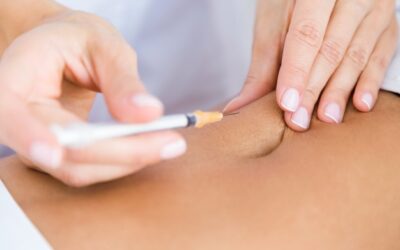
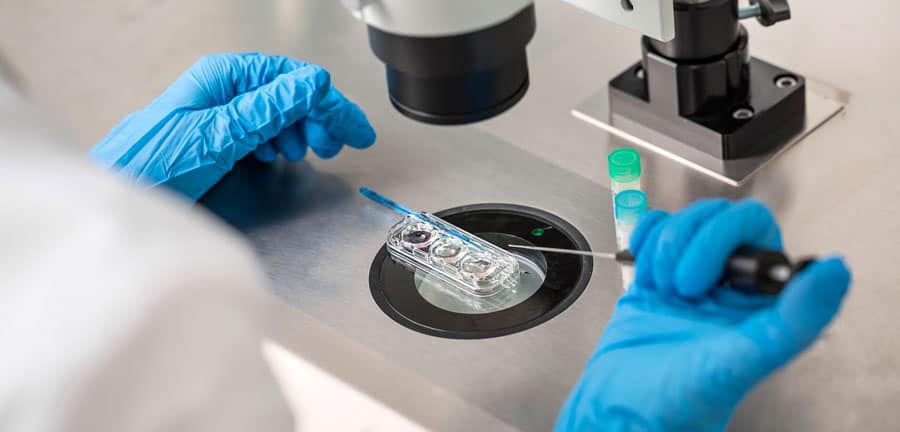
There are going to be many important moments throughout the course of your in Vitro Fertilisation treatment. One of them is the egg retrieval, the procedure during which your doctor will collect eggs from your ovaries to be used in the IVF laboratory in order to make...
Pregnancy after the age of 40, is possible?
If you have already turned 40 and are considering motherhood… the answer is yes: pregnancy after the age of 40 is possible. Is it difficult? Yes. But it’s not impossible, and with the right treatments you can conceive. The likelihood of getting pregnant naturally at...
I can’t get pregnant. What should I do?
You have decided it is time to grow your family so you start trying to conceive. The months go by but you haven’t gotten pregnant yet. So you think: I can’t get pregnant. What should I do? It is true that some women manage to conceive relatively quickly, but this is...
Ovarian stimulation in assisted reproduction
We answer your most frequently asked questions! It is completely normal to feel confused about certain concepts related to assisted reproduction treatment. One of these is the ovarian stimulation which is a process that tends to make our patients worry and have lots...
Secondary infertility: when a second pregnancy doesn’t come
Today we want to talk to you about something that is not uncommon at URE Centro Gutenberg. Something we see happen in more than one couple or single mother that come to our fertility clinic in Spain for treatment. Let us set the stage: you have already had one child...
Overweight and obesity: an obstacle in the way of becoming parents?
It’s a reality that overweight and obesity are increasingly more common in developed countries. These conditions are also associated with many health issues. Obesity is the result of the interaction of several factors, mainly those of genetic, metabolic,...
The male factor represents 35% of primary infertility cases
When we talk about primary infertility we are referring to couples who have not been able to conceive after a year of having sexual intercourse without using birth control methods. This period of time, in fact, is shorter for women over 37 years of age ( six months)...
También te puede interesar…
Healthy practices for good reproductive health
What is reproductive health and how can you take care of it naturally? Reproductive health is an essential part of each person's overall well-being and sexual and reproductive health. Understanding what reproductive health is is the first step towards taking care of...
My experience with assisted reproduction at URE Centro Gutenberg: I wish everyone could have it.
Hopefully all of them: a story of hope in assisted reproduction at URE Today we want to share a very special story. A patient wanted to recount her experience with assisted reproduction at URE Centro Gutenberg with a message full of encouragement for all of you who...
The impact of infertility on couples
At present, 17.5 % of couples worldwide are dealing with impact of infertility. In Spain, one in every five couples is struggling with fertility issues, and about 56 % of those one in five couples have started to undergo assisted reproduction treatment. ...