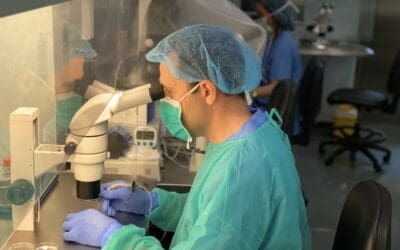
The embryo freezing by vitrification, or ultra‑rapid freezing, is one of the assisted reproduction techniques we perform at URE Centro Gutenberg. It’s a very useful procedure as it allows us to preserve the embryos that aren’t going to be transferred in the same...
Redacción URE
Egg Donation: Common Questions That Come Up
Egg donation is one of the assisted reproduction treatments (ART) we perform at URE Centro Gutenberg and is also a type of treatment that raises several questions we would like to answer in this article. Egg donation makes it possible for women who cannot get pregnant...
Microbiota and fertility: will probiotics increase my chances of conceiving?
Human beings are made up of, among many other things, bacteria. In fact, our body accumulates so much that it’s been calculated that for each human cell there are about ten bacteria. To give you a better idea, all of the bacteria that live inside of us may make up...
Basic fertility study: what tests are needed?
Many couples ask us when they should start looking into assisted reproduction if they want to have kids. And our response is always the same: if you haven’t conceived naturally after a year of regular, unprotected intercourse, we recommend that you visit a specialist...
Louise Brown in Malaga: how we celebrated the 30th birthday of our first IVF baby
We celebrated our thirtieth anniversary just three years ago. Since those first steps back in 1987, it wasn’t until ‘89 that the founder of URE Centro Gutenberg, Dr. Manuel Martínez Moya, and his team made Lorena’s birth a reality. She was the first baby born as a...
Frozen embryo transfer: frequently asked questions about this assisted reproduction treatment
The frozen embryo transfer is a treatment we perform at our fertility clinic in Spain in cases where we were able to freeze embryos that were previously created in a cycle of in vitro fertilisation treatment, regardless of whether the embryos were made using own eggs...
Refractory endometrium and assisted reproduction
In assisted reproduction treatment there are two fundamental objectives in order to achieve a pregnancy which will go on to develop correctly. The first objective is to have at least one embryo for the embryo transfer, and the second is to help the female achieve...
How does age impact male fertility?
A lot is said about the age of the female and how it relates to fertility, but little about how the age of the male impacts fertility when it comes to trying to conceive. As you have likely read in previous blog posts, you will not be surprised when we tell you that...
What is pre-implantation genetic diagnosis, or PGD?
Pre-Implantation Genetic Diagnosis (PGD) is a technique used in addition to In Vitro Fertilization (IVF) in couples at risk of passing on chromosome or genetic abnormalities to their offspring, among other causes. It involves carrying out sophisticated genetic...
Eggs classifications: How we classify eggs in In Vitro Fertilisation?
What is an egg cell? Eggs are sex cells, or the female gametes, which carry the genetic material a woman will pass on to her children. At first glance, eggs are large, spherical cells that are produced approximately every 28 days in the female’s ovary. And as you...
También te puede interesar…
Frozen embryo transfer: Natural cycle or substituted cycle?
The frozen embryo transfer is a fundamental treatment in assisted reproduction and is a common part of many in vitro fertilisation (IVF) processes, both with the patient's own oocytes and with egg donation. Thanks to the vitrification technique (ultra-rapid freezing...
What does an initial fertility consultation involve?
At the Gutenberg Centre Reproduction Unit, your first fertility consultation is free and lasts approximately one hour. During this time, one of our specialist doctors will thoroughly examine your case in order to offer you a clear diagnosis and a personalised...
Risks of multiple pregnancies: what they are and how to prevent them
More than 40 years ago, the main objective of assisted reproduction was to achieve the much-desired pregnancy, often without considering the risks of multiple pregnancies. To increase the chances of success, it was common to transfer two, three or even four embryos in...