Platelet-rich plasma, or PRP, is a medicine intended for human use which has been utilised clinically for many years in different medical specialties, particularly traumatology, dermatology and ophthalmology cases.
Use of this technique in assisted reproduction and fertility treatment remains experimental; however, the results obtained thus far are very promising, especially in patients with endometrial pathologies.
What is platelet-rich plasma, and why is it used in assisted reproduction?
Physiologically speaking, right after an egg is fertilised, the resulting embryo needs to implant in the endometrium, or the inner-most layer of the uterus.
For this to take place, both the embryo and the uterus depend on the secretion and suppression of specific proteins that encourage embryo implantation.
In order for the uterus to be properly prepared, a combination of important proteins is necessary; this includes the production of a variety of cytokines and growth factors which help to stimulate growth of the endometrial lining.
The above-mentioned growth factors include ones that can contribute to protecting the endometrium against fibrosis and serious scars, others that encourage endometrial tissue repair, and finally those that are crucial to initial embryo development and implantation.
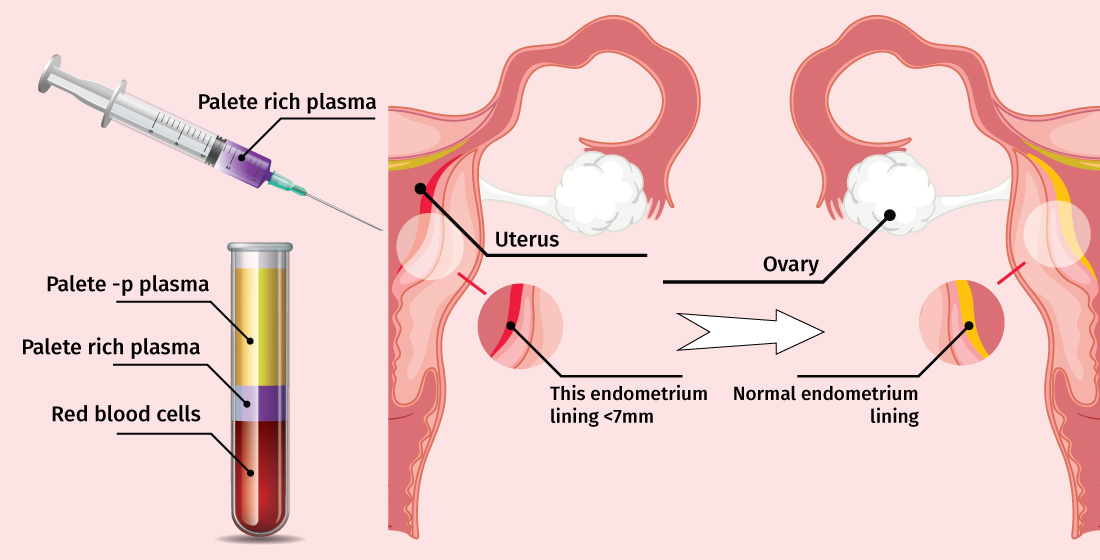
Platelet-rich plasma, or PRP, is based on obtaining proteins from a sample of the patient’s own blood.
During blood sample processing, platelets are activated and a large quantity of active growth factors, proteins and cytokines are obtained. These substances, which were present in the platelets, are released into the endometrial cavity where a number of biological processes are then triggered on a cellular level, including the repair and regeneration of cells and tissue, a decrease in inflammation and a lowered risk of infection.
This is the basis for the use of PRP in assisted reproduction, as the effects mentioned above contribute to improving both the thickness of the endometrial lining as well as the way it functions.
In what cases is platelet-rich plasma recommended?
Many scientific studies are already indicating that intrauterine PRP is an easily-accessible and affordable therapy which could contribute to fertility treatment by helping prepare the endometrium for implantation, thus encouraging communication between the embryo and the uterus.
At URE Centro Gutenberg, we have been offering this therapy for quite some time. Our results are promising, including a high rate of pregnancies that go on to develop properly, and a low risk of miscarriage in patients who have been previously diagnosed with a refractory or inadequate endometrium, or implantation failure due to issues with the endometrium.
What does the PRP procedure involve?
The procedure is very simple. After first signing an informed consent form, a blood sample is drawn from the patient. The sample is processed in order to separate the blood into its main components: red blood cells, white blood cells and plasma containing platelets. The plasma, once prepared, will be activated using PRGF® (Endoret®) technology.
The sample obtained is placed in the interior of the uterus a few days before the embryo transfer using an artificial insemination catheter. This therapy can be carried out on 1, 2 or 3 separate occasions, with a margin of at least 48 hours between each session. It is a low-risk, outpatient procedure.
Have we answered all your questions? Do you have any other questions about platelet-rich plasma?
Do you have any other questions about platelet-rich plasma?
If you’re thinking about starting treatment with us or are simply interested in receiving information, you can request an appointment for an initial case assessment. This first appointment is completely cost-free and can be scheduled as an in-person or remote consultation.