

When you are trying to conceive, and especially during the two-week wait after an assisted reproduction treatment, any small change can raise a lot of questions. One of the things that worries patients most is light bleeding before the pregnancy test.
Could it be so-called implantation bleeding? What is it usually like? Can it be told apart from a period? And what should you do if it appears after artificial insemination or an embryo transfer? In this article we explain what implantation bleeding is and when it can appear. We also explain why this spotting should not be taken as either confirmation or ruling out of a pregnancy.
What is embryo implantation?
Embryo implantation is the process in which the embryo, by then at the blastocyst stage, comes into contact with the endometrium, attaches to it and begins to embed itself in this tissue.
The endometrium is the layer that lines the inside of the uterus, and in each cycle it gets ready to receive the embryo. For implantation to happen correctly, a competent embryo and a receptive endometrium need to communicate in a coordinated way. From that moment on, the structures that allow oxygen and nutrients to pass between the mother and the baby begin to develop.
When does embryo implantation take place?
After fertilisation, the embryo begins to divide as it travels towards the uterine cavity. Around the fifth or sixth day of development it reaches the blastocyst stage and the implantation process can begin.
In a natural pregnancy, implantation usually begins roughly six to ten days after fertilisation. The exact moment can vary from one woman to another and from one pregnancy to another. In assisted reproduction, it also depends on the treatment carried out and on the embryo’s stage of development:
- After artificial insemination, the timing is similar to that of a natural pregnancy, and implantation begins approximately 7 days after the intrauterine insemination.
- After the embryo transfer of a day-five blastocyst, implantation can begin in the days following the transfer.
However, it is not possible to know the exact moment an embryo implants, nor to identify it through symptoms.
What is implantation bleeding?
With all of the above in mind, implantation bleeding is the light bleeding that can occur a few days after the embryo implants. This happens in approximately three in every ten women, and there is a reason for it. To keep developing, the embryo needs to start receiving nutrients from its mother’s body. To do so, it has to communicate with the mother’s endometrium, and during this process some blood vessels in the endometrium may break. New vessels then form in their place, giving the embryo everything it needs for its early development. This is what can cause what we call implantation bleeding. As mentioned above, this vaginal bleeding does not always happen, nor does it look the same in every case. Some women may not notice it at all, while for others it could resemble a period. The important thing is to know how to tell it apart and avoid unnecessary scares.
What does implantation bleeding look like?
Although it can show up differently in each woman, so-called implantation bleeding usually has some common features:
- It is light spotting.
- It is usually pink or brown.
- It does not usually become heavier over time.
- It may appear just once or on and off.
- It usually lasts less than a period.
- It may come with mild abdominal discomfort, similar to premenstrual symptoms.
The colour of the blood alone does not tell you the cause of the bleeding. What really matters is how much there is, how it develops and whether it comes with other symptoms.
How can you tell implantation bleeding from a period?
Telling possible implantation bleeding apart from the start of a period is not always easy, especially because both can appear around the same time. As a general guide, implantation bleeding tends to be lighter and shorter, and it does not get heavier as the hours go by. It is usually brown or pinkish, and its duration follows no set pattern. It may happen only once or last several hours. Sometimes it can go on for several days as light, intermittent spotting without turning into a period. A period, on the other hand, usually starts as spotting that gradually turns into a heavier flow and lasts several days. 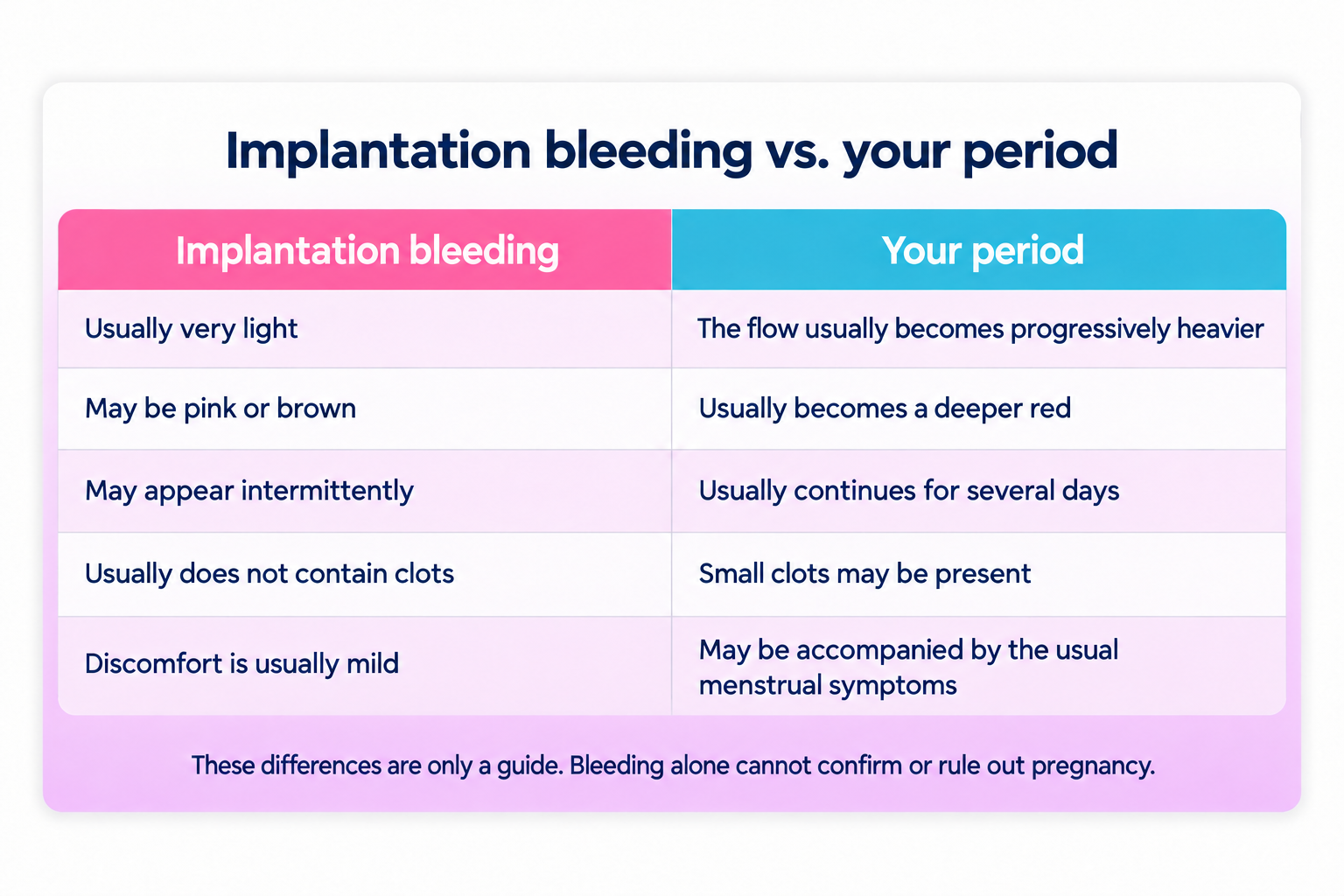 These differences are only a guide. The appearance of the bleeding cannot confirm whether implantation has taken place, whether your period is starting or whether there is another cause. The only way to know if you are pregnant is to take the beta-hCG test on the date set by your medical team.
What should you do if you have implantation bleeding?
If you notice spotting after artificial insemination or an embryo transfer, we recommend that you follow these guidelines:
- Do not stop or change your medication on your own. Keep to the prescribed schedule until your medical team tells you otherwise.
- Do not assume the treatment has failed. Light bleeding does not tell you whether or not you are pregnant.
- Do not take the pregnancy test early. Testing too soon can give a negative result even if implantation has taken place.
- Keep an eye on how much you are bleeding and how it develops. You should also watch out for pain or any other symptoms.
- Get in touch with your clinic. Your medical team will be able to assess your situation and give you personalised advice.
Even if the bleeding looks like a period, it is important to take the beta-hCG test on the scheduled date, unless your doctor tells you otherwise. As you have read, this is not something to be alarmed about, but it is good to understand it, and we know that many mothers-to-be worry when it happens to them. So don’t hesitate to contact us if you find yourself in this situation. We will do everything we can to help you.
Frequently asked questions about implantation bleeding
Does implantation bleeding confirm a pregnancy?
No. Implantation bleeding cannot be considered a reliable sign of pregnancy. Some women have a little spotting and later get a positive result. Others have no bleeding at all and also become pregnant. Some women also start spotting before the test, think it is their period, and end up with a positive beta-hCG.
Do all women have implantation bleeding?
No. Many women have no spotting at all during implantation and still go on to have an ongoing pregnancy. Not bleeding does not mean the embryo has not implanted.
How long does implantation bleeding last?
It is usually light and brief, although how long it lasts can vary. It may appear just once or come and go for a short time. If the bleeding continues, gets heavier or worries you, you should consult your medical team.
Can implantation bleeding be red?
There may be a little reddish, pink or brown spotting. The colour alone does not tell you the cause. It is more important to look at how much there is, how it develops and whether there are other symptoms.
Can implantation bleeding have clots?
Bleeding attributed to implantation is usually very light and does not normally contain clots. If the bleeding is heavy or you notice clots, consult your medical team.
Can I take a pregnancy test if I have had bleeding?
Yes, but you should take it on the scheduled date. If you are undergoing assisted reproduction treatment, do not take the test early or stop your medication, even if you notice bleeding.
Can I be pregnant even if it looks like my period has started?
Yes. Some women have bleeding before the test and later get a positive beta-hCG result. That is why you should take the test on the scheduled day and wait for instructions from your medical team.
Bleeding during the two-week wait: don’t jump to conclusions
We know that seeing blood during the two-week wait can be frightening and make you think straight away that the treatment hasn’t worked. However, a little spotting neither confirms nor rules out a pregnancy. Do not stop your medication, take the beta-hCG test on the scheduled date and contact our team so we can assess your case and support you through these days of uncertainty. At URE Centro Gutenberg, we are by your side before, during and after your assisted reproduction treatment.
Dr. Claudio Álvarez Gynaecologist – Reproductive Medicine Specialist
URE Centro Gutenberg